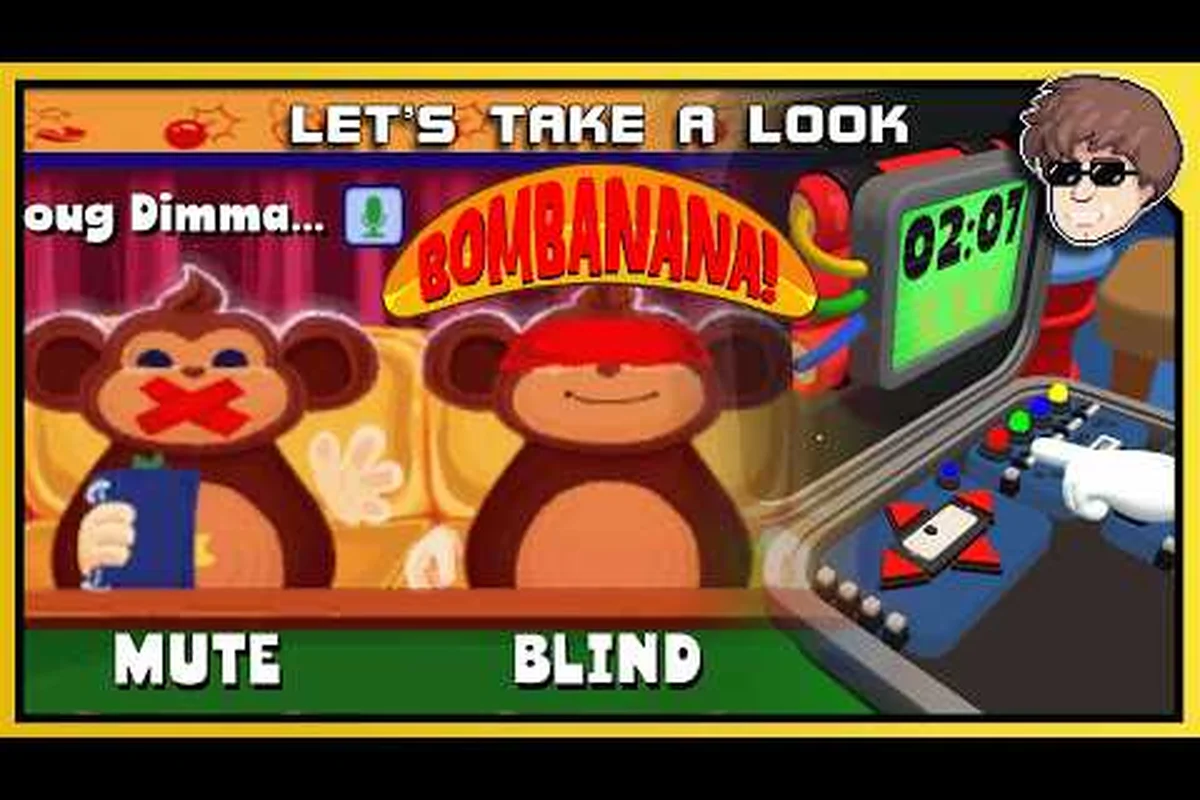
You and two friends are crammed into a minivan-turned-bomb-workshop, and one of you cannot see, one cannot hear, and one cannot speak. That is the entire premise of BOMBANANA, a three-player co-op defusal game where every second counts and communication is your only real weapon. This BOMBANANA beginner guide walks you through the three asymmetric monkey roles, the core defusal loop, and the communication habits that separate successful trios from piles of banana-flavored ash.
The game launches September 2, 2026 on Steam, but a free demo has been live since June 15, 2026 and already holds an Overwhelmingly Positive rating across more than 5,000 reviews. That means you can start practicing right now without spending a cent. Whether you are a complete newcomer or have dabbled in the demo, this BOMBANANA getting started guide gives you the exact framework you need to defuse your first bombs, avoid the most common rookie mistakes, and build a communication system that scales as the puzzles get nastier.
Understanding the BOMBANANA role system
| Role | Information Available | Information Missing |
|---|---|---|
| Blind Monkey | Cannot see the bomb modules | Can hear audio cues and receive verbal instructions |
| Deaf Monkey | Can see the bomb modules | Cannot hear audio cues or voice chat |
| Mute Monkey | Can see and hear everything | Cannot speak or communicate verbally |
Every round of BOMBANANA drops your three-player team into a minivan packed with a ticking bomb, and each player takes on one of three deliberately handicapped roles. The Blind Monkey wears a blindfold and cannot see the bomb at all, but they can hear every beep and mechanical click. The Deaf Monkey can see the bomb perfectly but cannot hear any audio cues, which means they rely entirely on visual inspection. The Mute Monkey can both see and hear the bomb, but they cannot speak, so they must communicate through gestures, pointing, and physical interaction with the modules.
The brilliance of this design is that no single player ever has the full picture. The Blind Monkey knows when the bomb is about to explode but has no idea which wire to cut. The Deaf Monkey can read the module instructions but cannot tell when the timer is running out. The Mute Monkey understands everything but cannot verbalize it. According to the official Steam page, the core loop is built around this exact tension: each of them only has part of the information, and they must work together to defuse the bomb before everyone goes BOOM.
How the defusal loop actually works
Each bomb contains a series of puzzle modules that must be solved in sequence. Modules range from wire-cutting puzzles to sequence-memory challenges, and each one requires different information from different roles. The Blind Monkey might hear a specific pattern of beeps that tells the team which wire to cut, while the Deaf Monkey reads the module's visual instructions to confirm the sequence.
The key insight for any BOMBANANA new player guide is that your role is not a limitation — it is your specialty. The Blind Monkey should focus entirely on auditory information and announce every sound they hear. The Deaf Monkey should narrate everything they see on the bomb's surface. The Mute Monkey should position themselves where they can physically guide the other two, using hand signals and body language to bridge the gap.
| Role | Can See | Can Hear | Can Speak | Primary Responsibility |
|---|---|---|---|---|
| Blind Monkey | No | Yes | Yes | Listen for audio cues, announce beeps and clicks |
| Deaf Monkey | Yes | No | Yes | Read modules visually, describe wire colors and symbols |
| Mute Monkey | Yes | Yes | No | Bridge information, use gestures and physical guidance |
Building your communication system early
The single biggest mistake new trios make is treating BOMBANANA like a traditional co-op game where everyone can just shout information freely. That approach collapses the moment the timer hits thirty seconds and three people are screaming over each other. Instead, successful teams build a structured communication system before they ever touch a bomb, and this BOMBANANA starter guide recommends establishing clear protocols in your first few practice rounds.
Start by assigning each player a callout priority. The Blind Monkey owns all timer information because they are the only one who can hear the countdown. The Deaf Monkey owns all visual module descriptions because they are the only one who can see the bomb clearly. The Mute Monkey owns the physical space, positioning themselves to point, nod, and guide the other two through the process. When everyone knows who owns which information channel, the chaos becomes manageable.
The three-phase callout framework
Community reports from the official Discord server suggest that the most effective trios use a three-phase framework for every module. The first phase is observation, where the Deaf Monkey describes what they see while the Blind Monkey reports what they hear. The second phase is confirmation, where the Mute Monkey physically verifies the information by touching the correct wire or module component. The third phase is execution, where the team commits to an action based on confirmed information.
This framework matters because it prevents the most common failure mode: acting on unverified information. A Deaf Monkey might see a red wire and assume it is the correct cut, but if the Blind Monkey heard a different pattern, the team needs a way to reconcile those inputs. The Mute Monkey serves as the tiebreaker, physically checking the module against both descriptions before anyone touches a wire.
Mastering the three monkey roles in depth
| Metric | Value |
|---|---|
| Full game release date | September 2, 2026 |
| Free demo release date | June 15, 2026 |
| Demo player reviews | 5,066 |
| Demo review rating | Overwhelmingly Positive (97%) |
| Required players per match | 3 |
| Supported platforms (demo) | Windows, macOS |
While the basic role descriptions are simple, each monkey has a deeper toolkit that most BOMBANANA how to play content barely scratches. The Blind Monkey, for instance, can learn to distinguish different beep frequencies that correspond to different module states. A low, steady hum might indicate a stable module while a high-pitched rapid beep signals an imminent failure. Veteran players report that the Blind Monkey becomes the de facto team leader because they hold the most time-critical information.
The Deaf Monkey, meanwhile, develops a visual language for reading modules quickly. Since they cannot hear the bomb's internal clicks, they must memorize the visual patterns of each module type. The demo includes a Free Mode where you can design your own bomb, and the official Steam page confirms this is an excellent training tool. Build a bomb with only wire modules and practice your visual reading speed until you can describe a module in under five seconds.
Advanced Blind Monkey techniques
The Blind Monkey's auditory toolkit goes far beyond simple timer tracking. Experienced players report being able to identify specific module types purely by their sound profiles. A wire-cutting module produces a distinct metallic shuffle when the bomb shifts, while a sequence-memory module emits a soft electronic hum that changes pitch with each correct input.
Your job as the Blind Monkey is to build a mental library of these sounds and communicate them clearly. Instead of saying "I hear something," describe the sound precisely: "I hear a high-pitched beep followed by two low clicks." This gives the Deaf Monkey enough detail to cross-reference with what they see on the module. According to community testing, trios that develop this level of auditory precision defuse bombs roughly twice as fast as teams that rely on vague descriptions.
Advanced Deaf Monkey techniques
The Deaf Monkey's challenge is that they must translate visual information into verbal instructions without any audio feedback. This means developing a consistent vocabulary for describing modules. Instead of saying "there is a thing on the left," say "there is a two-position toggle switch on the upper-left quadrant, currently set to the right position."
The Level System in BOMBANANA adds another layer, as the official Steam page confirms that harder levels introduce more complex modules with additional visual elements. Your vocabulary must scale accordingly. Build a shared glossary with your team before attempting higher levels, and practice using the same words for the same visual elements every single time. Consistency is the foundation of fast communication.
Practical strategies for your first defusal attempts
Before you jump into random matchmaking, this BOMBANANA getting started guide strongly recommends running through the demo's tutorial levels with two friends. The demo includes a Level System that gradually introduces new module types, and the Steam page confirms it supports both Windows and macOS. Start with the simplest bombs and work your way up, focusing on communication quality rather than speed.
Your first few attempts will likely end in explosions, and that is completely normal. The key is to treat every failure as a communication audit. After each explosion, ask three questions: Did the Blind Monkey report all relevant sounds? Did the Deaf Monkey describe all visible elements? Did the Mute Monkey successfully bridge any gaps? Most failures trace back to one of these three breakdowns.
The 10-minute practice routine
Community reports from the official Discord suggest that a structured 10-minute warm-up dramatically improves success rates. Spend the first three minutes reviewing module vocabulary as a team, confirming that everyone uses the same words for the same visual elements. Spend the next four minutes running a single practice bomb in Free Mode, focusing purely on callout quality rather than speed. Spend the final three minutes debriefing, identifying which calls were unclear and how to phrase them better next time.
This routine works because it separates skill development from performance pressure. When you are not racing the timer, you can focus on building the communication habits that will carry you through harder levels. The demo's Free Mode is perfect for this, since you can design bombs that target your team's specific weaknesses.
Handling high-pressure moments
When the timer drops below fifteen seconds, most teams panic and abandon their communication framework. This is exactly when you need it most. The Blind Monkey should switch to a countdown cadence, announcing every second in a steady rhythm. The Deaf Monkey should prioritize the single most important visual detail and ignore everything else. The Mute Monkey should physically guide the other two toward the most critical module.
According to player experiences shared on the official Discord, the teams that succeed under pressure are the ones that simplify their communication rather than speeding it up. Short phrases like "cut red" or "toggle left" replace full sentences. The Mute Monkey's physical gestures become more exaggerated. Everyone accepts that they might not solve every module, and they focus on solving the one that matters most before the timer hits zero.
Avoiding common beginner mistakes
Every BOMBANANA new player guide should address the most frequent failure patterns, and the community has identified several that recur across nearly every new trio. The first is information hoarding, where one player tries to solve the entire bomb themselves instead of sharing what they know. The Blind Monkey might hear a critical sound but keep it to themselves while trying to figure out the full solution. This always ends badly because the other two players are working with incomplete information.
The second common mistake is over-talking, where all three players speak simultaneously and nobody can parse the information. This is especially dangerous for the Deaf Monkey, who cannot hear the Blind Monkey's timer warnings and might not realize how little time remains. Establish a strict speaking order and enforce it, even under pressure. Enforce a strict speaking order and stick to it even under pressure, and for a deeper breakdown of how to manage turn-taking and keep callouts clean in chaotic moments, see our Bombanana Communication Guide.
The role-swap training method
One of the most effective training techniques reported by the community is role-swapping during practice sessions. Have the Blind Monkey play as the Deaf Monkey for a few rounds, and vice versa. This builds empathy for each role's challenges and helps players understand what information their teammates actually need. The Mute Monkey benefits most from this exercise, as they learn to anticipate what the other two roles will ask for before they ask it.
Role-swapping also prevents the specialization trap, where players become so locked into one role that they cannot adapt when a teammate is unavailable. If your usual Blind Monkey cannot make it, a teammate who has practiced the role can step in without a massive drop in performance. The demo's Free Mode makes this easy to practice, since you can run multiple bombs in quick succession with different role assignments.
Frequently Asked Questions
How many players do I need to play BOMBANANA?
BOMBANANA is strictly a three-player co-op experience, and the official Steam page confirms there is no solo mode. You need exactly three players, each taking on one of the three monkey roles. The free demo supports this same structure, so you can test the game with two friends before committing to the full release.
Is BOMBANANA free to play?
The full game costs money and releases September 2, 2026, but there is a free demo available now on Steam. The demo includes the core defusal gameplay, the Level System, and Free Mode for designing custom bombs. According to the Steam page, the demo has over 5,000 reviews with an Overwhelmingly Positive rating of 97 percent.
What is the best way to practice before the full release?
Download the free demo and use Free Mode to design custom bombs that target your team's weaknesses. The official Steam page confirms Free Mode lets you build your own bomb layouts, which is perfect for practicing specific module types. Pair this with the role-swapping method to build a well-rounded team before the full launch.
Can I play BOMBANANA with random players online?
Yes, the full release supports online co-op, but this BOMBANANA beginner guide recommends starting with friends if possible. Random teammates may not have the same communication framework, which makes the already challenging gameplay even harder. The official Discord server is a good place to find players who are serious about building structured communication.
What happens if we fail to defuse the bomb?
The bomb explodes and the round ends, which is the game's primary failure state. According to the official Steam page, the goal is to defuse the bomb before it explodes using limited time and limited communication. Each failure is a learning opportunity, and the game's Level System ensures you face progressively harder challenges as your team improves.