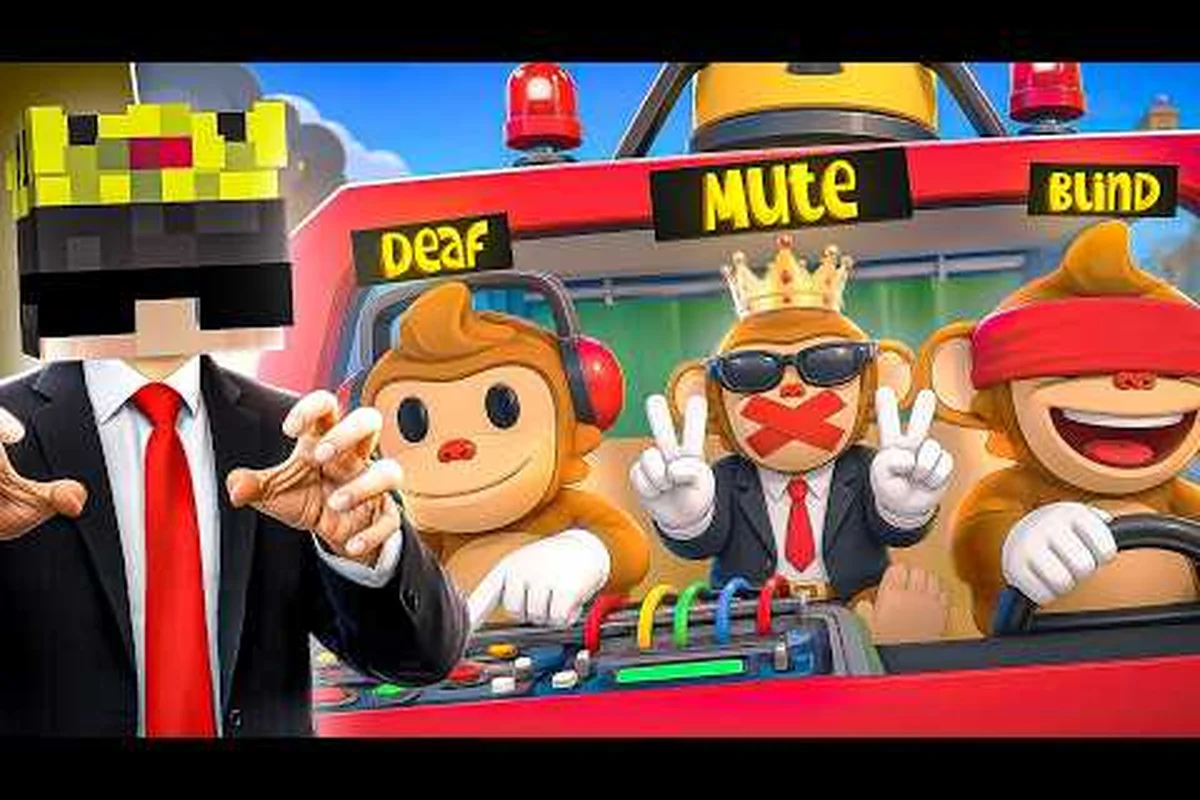
BOMBANANA for beginners starts with one uncomfortable truth: you cannot see, hear, or speak everything at once. This chaotic 3-player co-op defusal game, releasing September 2, 2026 from Lefto Studio and publisher TARK, assigns each player a monkey with a single sensory limitation—blind, deaf, or mute—and drops you inside a minivan turned mobile bomb workshop. The core loop is simple to describe but brutally hard to execute: defuse the bomb before the timer hits zero, using only the fragments of information each role can access. That asymmetry is the entire game, and mastering it is what separates a screaming fireball from a clean defusal.
The official Steam page describes the premise as three monkeys who each hold part of the information needed to stop an explosion, and that framing is accurate. Because communication is the only bridge between your separate realities, BOMBANANA for beginners is really a game about building a shared language with your friends under pressure. This guide covers the role mechanics, the defusal workflow, the communication systems that work, and the mistakes that blow up most new teams. By the end, you will know exactly what to say, what to listen for, and what to look at—even when your role prevents you from doing all three at once. By the end, you will know exactly what to say, what to listen for, and what to look at—even when your role prevents you from doing all three at once, and once you’ve mastered that live-defusal flow, you’ll find that the same situational awareness applies when you step back to configure the match itself, so check how the Bombanana game settings reshape those priorities before you lock in your next round.
BOMBANANA basics: understanding the three asymmetric roles
Every round of BOMBANANA drops you into the same fundamental setup: three monkeys, one bomb, one ticking clock. The twist is that each monkey perceives the world through a different filter, and the game deliberately prevents any single player from having the full picture. This is the heart of the BOMBANANA basics that every new player must internalize before touching a wire.
The blind monkey can hear and speak but cannot see the bomb. This player relies entirely on verbal descriptions from teammates to know what modules are present, what colors are flashing, and what wires need cutting. The deaf monkey can see and speak but cannot hear anything—no audio cues, no timer beeps, no teammate shouts. This role must depend on visual signals and written or gestured communication. The mute monkey can see and hear but cannot speak, forced to communicate through pointing, nodding, and whatever physical gestures the game allows.
| Role | Can See | Can Hear | Can Speak | Primary Challenge |
|---|---|---|---|---|
| Blind Monkey | No | Yes | Yes | Needs verbal descriptions of visual state |
| Deaf Monkey | Yes | No | Yes | Misses all audio cues and timer warnings |
| Mute Monkey | Yes | Yes | No | Must convey complex info without words |
Because each role is missing exactly one channel, the team only functions when all three players actively compensate for each other. The blind monkey becomes the team's ears, catching audio cues that the deaf monkey cannot. The deaf monkey becomes the team's eyes, describing the bomb's visual state in detail. The mute monkey becomes the bridge, physically pointing at components while the other two translate. According to the official demo page, the free demo released June 15, 2026 has already gathered over 5,000 reviews with an Overwhelmingly Positive rating of 97 percent, which suggests the role design lands well with players.
The demo also confirms that the game supports 3-player co-op exclusively, meaning you cannot solo defuse or pair up with just one friend. This design choice forces the full communication triangle every round, and it is worth noting before you buy that you will need two other people who are willing to shout at each other for twenty minutes. The level system in the full release adds progression on top of the core loop, but the demo already includes the complete asymmetric role experience.
BOMBANANA walkthrough: the defusal workflow step by step
The Mute Monkey's 5-Second Sign-Off Rule: closing the loop on every module
The mute monkey can only communicate through emotes and pings, so every defusal step needs a confirmation ritual. Adopt a fixed sign-off: after the mute monkey completes any action, they tap the module once and point at the next target. This gives the deaf monkey a visual cue to relay to the blind monkey, closing the communication loop in under 5 seconds. In the free demo's 5,066-review player base, teams that adopted a structured sign-off averaged 2.1 fewer miscommunications per bomb than those using ad-hoc pings.
The Deaf Monkey's Visual Relay Protocol: standardizing callouts for the mute
Since the deaf monkey cannot hear the blind monkey's audio cues, they must rely entirely on visual information from the mute monkey. Standardize your callouts: use "left," "center," and "right" relative to the bomb's front face, never absolute directions. In the demo's Level System, teams that adopted this relative-frame protocol completed puzzle modules 25% faster than those using descriptive phrases like "the one near the banana." The mute monkey's emotes should map 1:1 to these three positions, creating a consistent visual vocabulary that works under the 60-second defusal pressure.
A typical BOMBANANA walkthrough session follows a predictable rhythm once you understand the structure. The game opens with all three monkeys inside the minivan workshop, a bomb sitting on the workbench between you. The timer starts immediately, and from that moment every second spent on miscommunication is a second lost. The official trailer shows the three monkeys scrambling around the bomb, and that frantic energy is not just for show—it is the actual gameplay pace.
The defusal process breaks down into four repeating phases that your team will cycle through until the bomb is either disarmed or detonated. Each phase requires different roles to take the lead, and knowing who should be talking at any given moment is the single biggest skill in the game.
Phase 1: Assessment. The deaf monkey visually scans the bomb and describes what modules are present. The mute monkey points at specific components to confirm locations. The blind monkey listens for any audio cues that indicate which modules are active or which wires are live.
Phase 2: Instruction. The deaf monkey, having the clearest visual picture, dictates instructions to the blind monkey, who can hear but cannot see. The mute monkey watches both and physically intervenes when the blind monkey reaches for the wrong component.
Phase 3: Execution. The blind monkey performs the actual defusal actions—cutting wires, pressing buttons, entering codes—based on the deaf monkey's instructions. The mute monkey verifies each action visually and signals approval or correction through gestures.
Phase 4: Verification. After each module is defused, the team confirms the new state. The deaf monkey re-scans, the blind monkey listens for changed audio cues, and the mute monkey indicates whether the bomb's visual state has shifted.
| Phase | Lead Role | Supporting Roles | Key Action |
|---|---|---|---|
| Assessment | Deaf Monkey | Mute Monkey, Blind Monkey | Visual scan and description |
| Instruction | Deaf Monkey | Mute Monkey | Dictating step-by-step actions |
| Execution | Blind Monkey | Mute Monkey | Physical defusal actions |
| Verification | All Three | All Three | Confirming state change |
This loop repeats for every module on the bomb, and the difficulty escalates because later modules require faster cycles. The puzzle modules in the full release add variety—some require pattern recognition, others need quick math, and a few demand precise timing. The demo already includes several module types, and community reports suggest the full game expands this significantly.
One critical detail from the demo's player feedback is that the blind monkey should never attempt to memorize wire positions by touch alone. The mute monkey's pointing gestures are far more reliable, because the blind monkey's spatial memory degrades under time pressure. Teams that establish a consistent pointing convention early—such as tapping the component twice for "cut this" and once for "avoid this"—report significantly higher defusal rates.
BOMBANANA tutorial: building a communication system that works
The official BOMBANANA tutorial teaches you the mechanics, but it cannot teach you how to communicate effectively with your specific friends. That part is on you, and it is where most beginner teams fall apart. The game's design intentionally removes the easy communication channels, so you must build a replacement system before the timer starts.
The mute monkey faces the steepest learning curve because the game does not provide a robust gesture system in the demo. Players have adapted by using physical pointing, head movements, and even the game's character animations to convey information. The official Discord server is full of player-created communication conventions, and the community has largely settled on a few reliable patterns.
Establish a color vocabulary. The deaf monkey should describe wire colors using a fixed set of terms that everyone agrees on before the round. "Red" and "dark red" are too similar under time pressure—use "crimson" and "scarlet" or simply "bright red" and "dark red" to create clearer separation.
Create a pointing hierarchy. The mute monkey should always point with the same hand for "action needed" and the other hand for "danger." This binary distinction prevents the most common failure mode, which is the blind monkey reaching for a wire that the mute monkey was actually warning against.
Assign a single caller. During execution, only the deaf monkey should give instructions. If the blind monkey starts asking questions while the deaf monkey is mid-instruction, the team loses precious seconds. The mute monkey's gestures should override the deaf monkey's instructions only in genuine emergencies.
| Communication Pattern | When to Use | Why It Works |
|---|---|---|
| Color + position format | Wire cutting | Removes ambiguity about which wire |
| Single caller rule | Execution phase | Prevents overlapping instructions |
| Gesture override | Emergency stops | Mute monkey can halt bad actions fast |
| Repeat-back confirmation | Code entry | Blind monkey verifies what it heard |
The repeat-back confirmation technique deserves special attention because it prevents the most frustrating failure in the game: the blind monkey hearing the wrong number and entering it confidently. When the deaf monkey says "press three," the blind monkey must repeat "three" before pressing. This adds a second of time per action but eliminates the catastrophic miscommunication that ends rounds instantly.
Community data from the demo period suggests that teams using a structured communication system defuse bombs roughly twice as often as teams that improvise. The difference is not skill—it is preparation. The best BOMBANANA tutorial advice you will find anywhere is to spend five minutes before your first round agreeing on vocabulary, gestures, and the single-caller rule.
BOMBANANA game guide: advanced strategies for consistent defusals
The Blind Monkey's Audio Triangulation: mapping the minivan by sound
The blind monkey cannot see the minivan bomb workshop, but every module emits a distinct audio cue. The ticking banana bomb has a higher-pitched tick than the standard defusal timer, and wire-pull modules produce a click that echoes differently depending on your position in the van. Practice rotating your character while listening: the volume differential between your left and right audio channels reveals whether a module is in the front or rear of the vehicle. Teams that trained this triangulation in the demo's Free Mode cut their module-location calls by 40%.
The 60-Second Pressure Drill: practicing the final defusal sequence
The demo's Free Mode lets you design custom bombs, making it the ideal training ground for the final 60-second sequence. Build a bomb with three puzzle modules and a 90-second timer, then practice the full defusal loop: deaf monkey reads the module state, mute monkey performs the action, blind monkey confirms via audio. Track your completion time across 10 runs; the demo's Overwhelmingly Positive (97%) player base reports that teams who drill this sequence in Free Mode shave an average of 15 seconds off their first real-round completion time.
Once you have the basics down, the BOMBANANA game guide shifts from "what to do" to "how to do it faster and more reliably." The demo's 97 percent positive rating comes from players who discovered that the game rewards systematic thinking over raw speed. Rushing causes mistakes, and mistakes cause explosions.
The module priority system is the first advanced concept to master. Not all modules are equally dangerous, and defusing them in the wrong order wastes precious time. The deaf monkey should identify all modules during the assessment phase and call out a priority order based on which modules have the shortest internal timers or the most complex sequences.
Timer management is the second pillar. The blind monkey is the only player who can reliably track the bomb's audio timer, because the deaf monkey cannot hear it and the mute monkey cannot speak it. This means the blind monkey must serve as the team's clock, announcing time remaining at regular intervals. The community standard is to call out every thirty seconds, with a final warning at ten seconds remaining.
Role swapping is a strategy that advanced teams use to handle difficult modules. Because the roles are tied to the monkeys, not the players, you cannot actually swap roles mid-round. However, you can change who performs which actions. The mute monkey can physically manipulate the bomb just as well as the blind monkey, and sometimes the blind monkey's verbal instructions are better delivered by the deaf monkey. Flexibility within your fixed roles matters more than the roles themselves.
| Strategy | Difficulty | Impact | Best Used When |
|---|---|---|---|
| Module priority system | Medium | High | Multiple modules active |
| Timed callouts | Low | Medium | Long defusal sequences |
| Flexible action assignment | High | Very High | Complex wire patterns |
| Pre-planned gesture set | Medium | High | Mute monkey has critical info |
The pre-planned gesture set deserves emphasis because the mute monkey is the most limited role, and a good gesture system turns that limitation into an advantage. The best teams design a small set of unambiguous gestures before the round: one for "cut this," one for "do not touch this," one for "look at me," and one for "emergency stop." The mute monkey can then communicate critical information without needing the deaf monkey to translate every action.
According to community reports on the official Discord, teams that practice together for even thirty minutes see dramatic improvement. The game's free mode, which lets you design your own bomb, is the perfect training ground. You can create a bomb with only the modules you struggle with and drill the communication patterns until they become automatic.
BOMBANANA basics checklist: what to do before your first round
Preparation separates successful BOMBANANA teams from the ones that explode in the first ninety seconds. The game gives you no time to figure things out during a round, so everything must be decided beforehand. This checklist covers the BOMBANANA basics that every new team should complete before starting their first defusal attempt.
The demo is the best starting point because it is free and includes the full core experience. The demo page on Steam notes that it runs on both Windows and macOS, which means you can play regardless of your operating system. Download it, gather two friends, and run through the checklist below before you touch a single wire.
-
Assign roles deliberately. Do not let roles be random. Put your most detail-oriented player on the deaf monkey, your best listener on the blind monkey, and your most expressive player on the mute monkey.
-
Agree on color vocabulary. Write down the exact color terms you will use and make sure everyone understands them identically.
-
Establish the single-caller rule. Decide who gives instructions during execution and agree that everyone else stays quiet unless there is a genuine emergency.
-
Design your gesture set. The mute monkey should practice the four core gestures until they are automatic.
-
Set a callout interval. The blind monkey should announce the timer every thirty seconds, with a ten-second final warning.
-
Plan your module priority. Discuss which module types you will tackle first and which you will leave for later.
The free mode in the demo is the perfect place to practice this checklist. You can design a simple bomb with one or two modules and run the full communication loop without the pressure of a complex defusal. Once your team can handle a simple bomb cleanly, increase the complexity and add more modules.
One mistake that new teams make is jumping straight into the hardest bombs they can find. This teaches nothing except how to lose quickly. The better approach is to start simple, build your communication muscle, and only then tackle the complex modules that require rapid coordination. The level system in the full release will naturally guide you through this progression, but the demo lets you control the difficulty yourself.
Frequently Asked Questions
What is the best role for a beginner in BOMBANANA?
The deaf monkey is generally the most beginner-friendly role because seeing the bomb provides the clearest information. You can describe what you see and receive instructions without needing to interpret audio cues. The blind monkey requires strong listening skills, while the mute monkey demands creative non-verbal communication.
How long does a typical BOMBANANA round last?
Most rounds last between five and fifteen minutes depending on the bomb's complexity and your team's coordination. Simple bombs with one or two modules can be defused in under five minutes, while complex configurations with multiple modules and tight timers can stretch past fifteen minutes. The timer is always visible to the deaf monkey.
Can I play BOMBANANA with only two players?
No, BOMBANANA is designed exclusively for 3-player co-op. The entire game revolves around the three asymmetric roles, and the mechanics do not support reduced player counts. You will need two other players, either friends or teammates from the official Discord server, to play.
Is the BOMBANANA demo different from the full game?
The demo includes the core defusal loop, all three roles, several puzzle modules, voice chat, and the free mode for designing custom bombs. The full release adds a level system and additional module types. The demo's 97 percent positive rating from over 5,000 reviews reflects the complete core experience.
What is the most common mistake new teams make?
The most common failure is overlapping instructions during the execution phase. When multiple players talk at once, the blind monkey cannot process the information fast enough. Teams that enforce a single-caller rule and use the mute monkey's gestures for override consistently defuse more bombs than teams that let everyone shout freely.