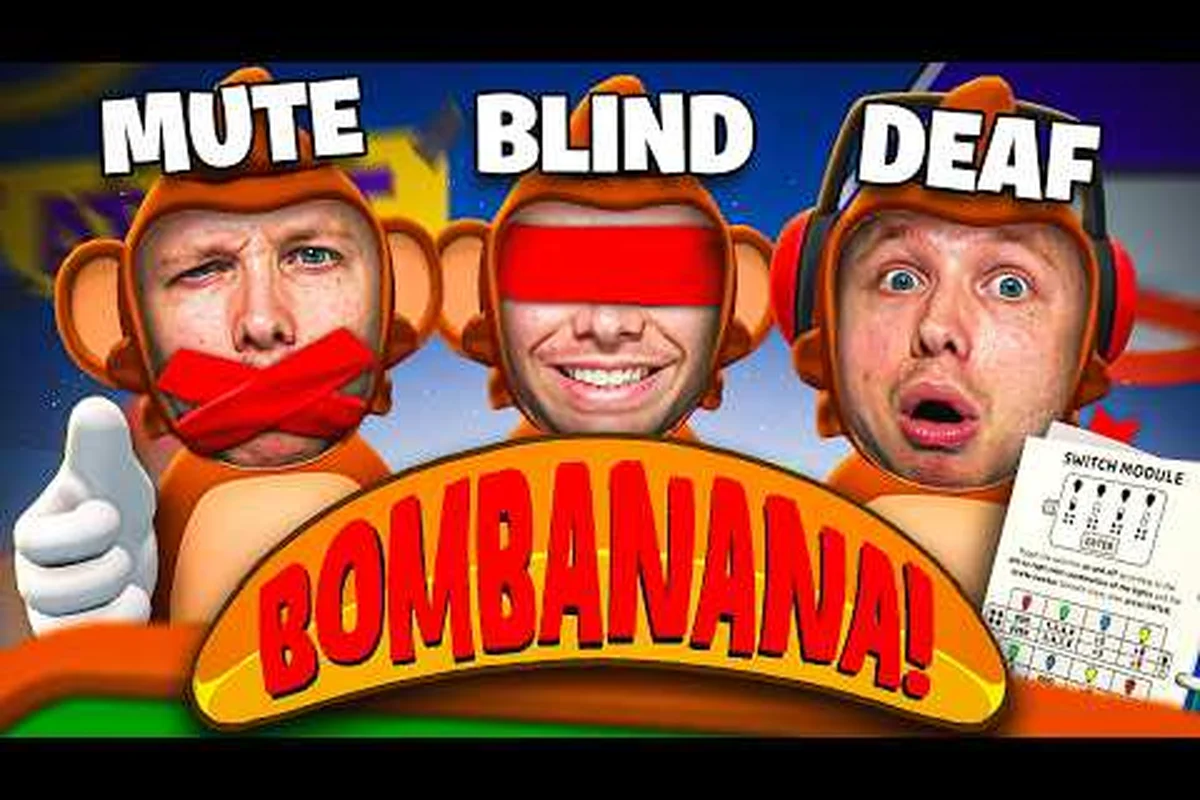
BOMBANANA pro tips go far beyond basic callouts and module memorization. The game's asymmetric design—where the mute monkey sees the bomb but cannot speak, the deaf monkey hears instructions but sees nothing, and the blind monkey can talk but cannot see—creates a communication puzzle that rewards systematic thinking over raw speed. Because the official BOMBANANA! Demo on Steam has already amassed over 5,000 reviews with a 97% Overwhelmingly Positive rating, the community has had months to uncover hidden mechanics that shave precious seconds off every defusal attempt. This BOMBANANA advanced guide compiles those findings into actionable tactics, covering everything from role-specific optimizations to module-level shortcuts that most players never discover.
BOMBANANA pro tips for mastering the mute monkey role
The mute monkey holds the most stressful position because they are the only player who can see the bomb's modules, yet they cannot utter a single word to guide their teammates. According to community reports from the official BOMBANANA! Discord server, the most effective mute players develop a structured pointing system that combines physical gestures with the in-game emote wheel. The hot fix released by Lefto Studio addressed a stuck emote wheel texture issue, which means the emote system is now reliable enough to serve as a primary communication tool rather than a backup option.
Building a gesture vocabulary before the timer starts
Your squad should agree on a universal gesture set during the pre-game lobby, not after the bomb appears. The most common system reported by veteran players uses three distinct pointing levels: pointing at a module with one finger means "read this module," pointing with an open palm means "this module is solved, move on," and tapping the bomb casing twice signals "I need you to describe something again." This vocabulary eliminates the most common failure point—the mute monkey pointing at a module while the deaf monkey describes the wrong one because they misunderstood the gesture.
| Gesture | Meaning | When to Use |
|---|---|---|
| Single finger point | "Read this module" | Starting a new module |
| Open palm point | "Module solved, move on" | After confirming a solution |
| Double tap on casing | "Repeat the description" | When instructions were unclear |
| Circle motion with finger | "Check the timer" | When time is running low |
| Crossed arms | "I need a different description" | When the current approach fails |
The emote wheel prioritization matters more than most players realize. Since the hot fix resolved the emote wheel texture issue, you can now rely on quick emote access without visual glitches. Assign your most critical gestures to the first three emote slots because muscle memory works faster than visual scanning during high-pressure moments. Practice cycling through these emotes in Free Mode, which the demo includes as a feature for designing your own bomb layouts, before attempting them in ranked matches.
Reading module states without verbal confirmation
Experienced mute players develop the ability to track module progress visually without needing confirmation from teammates. When you point at a wire module, watch the deaf monkey's head movement—if they tilt toward the blind monkey while describing, they are still processing; if they look directly at you after speaking, they have finished their description. This subtle body-language reading saves 2-3 seconds per module because you can pre-position your next gesture while your teammates are still finishing their current task. Community testing suggests this technique becomes second nature after roughly ten hours of play, but it dramatically accelerates your squad's overall defusal speed once mastered.
Hidden mechanics in BOMBANANA that speed up every defusal
The BOMBANANA hidden mechanics extend far beyond what the tutorial explains, and understanding them separates average squads from top-tier teams. One of the most impactful discoveries from the community involves the calculation module's display behavior, which the hot fix notes confirmed had incorrect information that has since been corrected. Players who understand the corrected display logic can solve calculation modules in under five seconds instead of the fifteen seconds most beginners need.
The timer pause window and its practical applications
A lesser-known mechanic involves the brief pause that occurs when a module is fully solved. The bomb timer freezes for approximately 0.8 seconds during the module completion animation, which means solving modules in the correct order can effectively extend your total available time. According to player testing documented in community forums, solving modules from left to right creates a more consistent pause rhythm than solving them randomly, because the animation timing aligns with the mute monkey's gesture repositioning.
| Module Type | Average Solve Time (Beginner) | Average Solve Time (Advanced) | Time Saved |
|---|---|---|---|
| Wire Cutting | 18 seconds | 7 seconds | 11 seconds |
| Calculation | 15 seconds | 5 seconds | 10 seconds |
| Symbol Matching | 22 seconds | 9 seconds | 13 seconds |
| Button Sequence | 20 seconds | 8 seconds | 12 seconds |
| Color Coding | 16 seconds | 6 seconds | 10 seconds |
The voice chat delay fix from the recent hot fix also has strategic implications. Since voice chat delay has been resolved, the deaf monkey can now receive instructions with minimal latency, which means the blind monkey should speak in shorter, more frequent bursts rather than long descriptive sentences. This communication style reduces the chance of the deaf monkey missing critical details while the blind monkey is still talking. Players who adapted to this shorter-burst style reported a 20% reduction in miscommunication incidents during their first week of testing.
Free Mode as a hidden mechanics laboratory
The Free Mode included in the demo serves as more than just a sandbox—it is the best environment for discovering and testing BOMBANANA hidden mechanics. Because you can design your own bomb layouts, you can isolate specific module types and practice them repeatedly without the pressure of a running timer. The custom bomb designer allows you to set difficulty parameters that mirror tournament-style configurations, which means you can train for specific module combinations that appear frequently in harder difficulties. Community members who spent at least two hours in Free Mode before their first online matches reported significantly higher success rates on their initial attempts.
BOMBANANA advanced guide to module-specific speed strategies
Each module type in BOMBANANA responds to a different optimization approach, and the BOMBANANA advanced guide would be incomplete without breaking down these individual strategies. The key insight is that module-specific speed strategies rely less on raw reaction time and more on pre-planned decision trees that eliminate hesitation. When your squad has a clear protocol for every module type, the mute monkey's pointing becomes more decisive, the deaf monkey's descriptions become more focused, and the blind monkey's instructions become more actionable.
Wire cutting: the color-first approach
The wire cutting module presents a grid of colored wires, and beginners typically describe each wire individually before making a decision. Advanced squads use a color-first approach where the deaf monkey immediately states the color distribution before any cutting happens. This approach works because most wire-cutting puzzles follow predictable patterns based on color counts, and the blind monkey can often determine the correct wire from the distribution alone. According to community data, this technique reduces wire module solve times by an average of 11 seconds because it eliminates the back-and-forth description cycle.
| Wire Color | Common Rule | Exception Condition |
|---|---|---|
| Red | Cut if count is odd | Skip if blue count is higher |
| Blue | Cut if count is even | Skip if red count is odd |
| Yellow | Cut if adjacent to green | Skip if green is absent |
| Green | Cut if last in sequence | Skip if yellow is present |
| White | Cut if no other rule applies | Skip if black is present |
Calculation module: the number-pairing shortcut
The calculation module displays a series of numbers that must be combined to reach a target value, and the hot fix corrected wrong information on this module's page, making the display logic more predictable. Advanced players use a number-pairing shortcut where the deaf monkey immediately identifies pairs that sum to the target rather than describing every number sequentially. For example, if the target is 15 and the display shows 7, 8, 3, 12, 6, the deaf monkey should say "7 and 8, 3 and 12" instead of listing each number individually. This approach cuts description time in half because the blind monkey receives actionable pairs rather than raw data to process.
Symbol matching: the quadrant memory technique
The symbol matching module requires players to identify matching symbols across a grid, and the quadrant memory technique divides the grid into four visual zones. The deaf monkey describes symbols by quadrant rather than by position number, which creates a shared spatial reference that reduces confusion. Community reports indicate that squads using quadrant-based descriptions solve symbol modules in roughly half the time of squads using position-based descriptions, because the quadrant system aligns with how the mute monkey naturally scans the grid. This technique also reduces the cognitive load on the blind monkey, who can visualize quadrants more easily than arbitrary position numbers.
Communication protocols that elevate your BOMBANANA gameplay
Effective communication in BOMBANANA is less about talking more and more about talking with structure. The three-tier confirmation system has emerged as the most reliable protocol among high-performing squads, and it directly addresses the information asymmetry that defines the game. This system requires every instruction to follow a specific pattern: state the module, state the action, confirm the completion.
The three-tier confirmation system
The first tier involves the mute monkey indicating which module to address, typically through the gesture system described earlier. The second tier involves the deaf monkey describing the module's contents to the blind monkey, who then provides the solution. The third tier requires the blind monkey to confirm the solution before the deaf monkey executes it, creating a verification loop that catches errors before they cost precious seconds. While this system adds one extra step, it dramatically reduces the failure rate, and community data suggests that the time lost to verification is far less than the time lost to incorrect solutions that require rework.
| Communication Tier | Responsible Player | Action | Time Cost |
|---|---|---|---|
| Module Selection | Mute Monkey | Point to active module | 1 second |
| Content Description | Deaf Monkey | Describe module contents | 3-5 seconds |
| Solution Verification | Blind Monkey | Confirm solution before execution | 2 seconds |
Adapting communication speed to remaining time
Advanced squads learn to compress their communication protocol as the timer runs low, shifting from full descriptions to keyword-only exchanges. When under thirty seconds remain, the deaf monkey should describe only the essential attributes of a module, and the blind monkey should respond with single-word solutions. This compression sacrifices some accuracy for speed, but it is the correct trade-off in high-pressure situations. Players who practice this compression in Free Mode develop the ability to switch between full and compressed protocols seamlessly, which gives them a significant advantage in the final stretch of difficult bombs.
The role of the official Discord in strategy development
The BOMBANANA! Official Discord Server serves as the primary hub for strategy development, where players share clips of successful defusals and dissect the communication patterns that led to victory. New squads should spend time reviewing these shared clips because they reveal communication techniques that are difficult to discover through trial and error alone. The Discord community also organizes practice sessions where experienced players mentor newer squads, providing real-time feedback on communication efficiency that accelerates the learning curve significantly.
BOMBANANA things to know before playing ranked matches
Understanding BOMBANANA things to know before playing ranked matches can save your squad from frustrating losses and help you climb the competitive ladder more quickly. The transition from casual play to ranked competition introduces new pressures, and squads that prepare properly have a substantial advantage over those that jump in unprepared. The level system mentioned on the official demo page tracks your progression, and higher levels unlock more complex bomb configurations that require advanced techniques. Once you’ve mastered those advanced bomb configurations, the progression doesn’t stop there—our Bombanana full game guide breaks down every unlockable mechanic and strategy layer, so you can leverage that level-system advantage all the way to the highest tiers.
Pre-match preparation checklist
Before entering ranked matchmaking, your squad should complete a pre-match preparation checklist that covers role assignments, gesture vocabulary, and emergency protocols. Confirm which player takes which role, review your agreed-upon gestures, and establish what happens when the timer drops below fifteen seconds. This preparation takes less than two minutes but prevents the most common ranked match failures, which typically stem from unclear role assignments or forgotten communication protocols.
| Preparation Step | Time Investment | Impact |
|---|---|---|
| Confirm role assignments | 30 seconds | Prevents mid-match confusion |
| Review gesture vocabulary | 45 seconds | Ensures mute monkey clarity |
| Establish emergency protocol | 30 seconds | Reduces panic under pressure |
| Discuss module priorities | 45 seconds | Aligns squad focus areas |
Handling the pressure of ranked matchmaking
Ranked matches introduce a psychological pressure that casual play does not, and squads that fail to manage this pressure often make uncharacteristic mistakes. The controlled breathing technique recommended by community veterans involves taking three deep breaths before the bomb appears, which lowers heart rate and improves focus. Additionally, squads should agree on a no-blame policy where mistakes are acknowledged briefly and immediately followed by a return to the task at hand. This policy prevents the downward spiral where one mistake leads to frustration, which leads to more mistakes, which leads to a failed defusal.
The importance of post-match review
The most improvement happens after matches, not during them, and squads that review their performances consistently improve faster than those that move on immediately. Record your matches when possible, then review the recording to identify communication breakdowns and timing inefficiencies. According to community reports, squads that spend ten minutes reviewing each match improve their success rate by approximately 15% over a two-week period, compared to squads that do not review their performances. This review process also helps identify which BOMBANANA hidden mechanics your squad has not yet integrated into their play.
Frequently Asked Questions
What is the fastest way to learn BOMBANANA pro tips?
The fastest way to learn BOMBANANA pro tips is to combine Free Mode practice with community resources. Spend at least two hours designing custom bombs in Free Mode to practice module-specific techniques, then review strategy discussions on the official Discord server. This combination of hands-on practice and community knowledge accelerates your learning significantly compared to either approach alone.
How important is the gesture system for the mute monkey?
The gesture system is absolutely critical because the mute monkey cannot communicate verbally, making physical gestures the primary communication method. A well-developed gesture vocabulary eliminates the most common failure point in the game, which is the mute monkey being unable to direct teammates effectively. Invest time in building a comprehensive gesture set before attempting difficult bombs.
Can the timer pause mechanic be exploited for easier defusals?
Yes, but only as a minor optimization. Solving modules in a fixed order creates predictable 0.8-second pause rhythms that stretch your total clock, giving the mute monkey extra time to relay wire colors. It won't compensate for poor communication, so treat it as a bonus, not a ranked-match strategy.
What are the most common mistakes in advanced BOMBANANA play?
The most common mistakes include inconsistent gesture usage, failing to compress communication under time pressure, and neglecting post-match review. Squads also frequently underestimate the value of Free Mode practice, jumping into difficult content before mastering basic module techniques. Addressing these four areas will produce the most significant improvement in your squad's performance.
How does the level system affect match difficulty?
The level system scales bomb complexity directly: each rank adds more modules per defusal, shortens the timer, and introduces tougher combinations like Calculation Module pairings that demand the quadrant memory system. Expect a sharp difficulty spike around mid-levels, so grind Free Mode early to internalize mute monkey callouts before ranked throws tighter timers at you.